
Global EV sales will be close to 90% by 2030, study finds
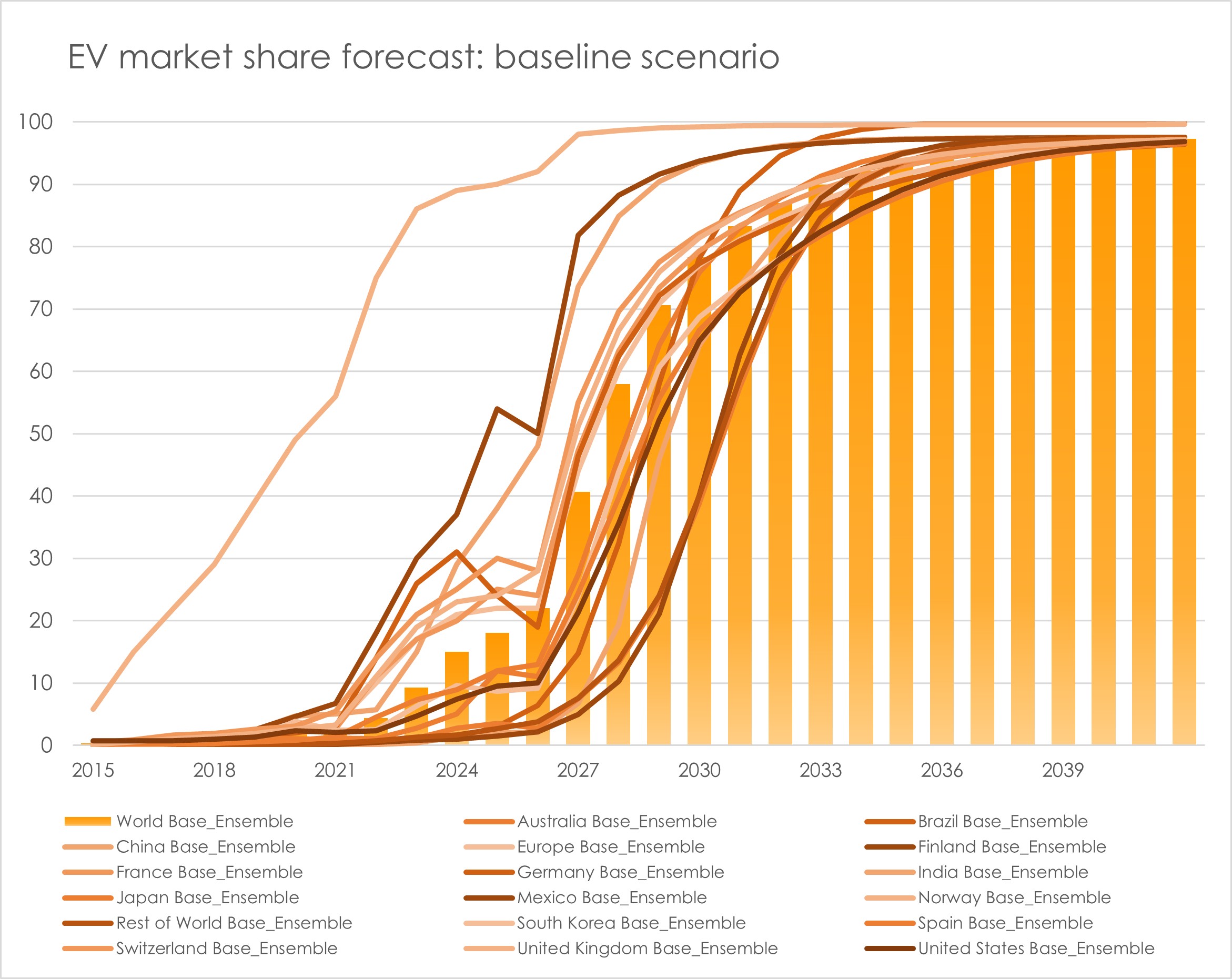
Using sophisticated AI tools, a new study predicts that global electric vehicle sales are highly likely to reach complete global market dominance by 2030.
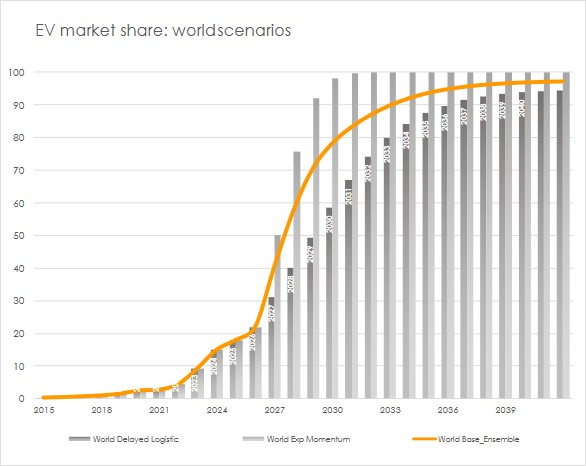
The study Changing seat: competitiveness-based forecasting the car industry uses a range of different forecasting models. Based on historic data, technology penetration curves, and competitiveness parameters, sales of EVs will represent between 65 and 95% of all vehicle sales, with higher certainty on the upper level.
Modelling & forecasting vehicle sales by country, technology, and brand
The next five years will likely determine which companies successfully navigate this transition and which companies become casualties of technological and market disruption.
Electric power trains have much higher energy efficiency compared to combustion engines: the theoretical max efficiency of a gasoline engine is roughly 35%, for electric motors that number is 100%. In practice, efficiency for internal combustion engine vehicles (ICE) is about 22% on the wheel, compared to 80-90% for EVs – a factor of 1:4. EVs therefore have much lower operating costs. In addition, EVs don’t need engine bonnets, and no transmission and gear box, translating in simpler and cheaper production. Less moving parts also mean less maintenance, and no need for oil changes.
The global EV market shows accelerating adoption, with worldwide penetration reaching 22% in 2024. Projections indicate potential market dominance somewhere between 2027-2035, driven by new model line-ups, declining battery costs, expanding charging infrastructure, and digital system integration. The accelerating transition reflects economic fundamentals including purchase cost parity achievement and significant maintenance cost advantages over internal combustion engines.
In light of the technological superiority of electric vehicles, initial cost parity giving way to cost advantage, lower maintenance & operating cost, as well as technological adaption, most market transmission forecast seem rather conservative. This forecast is based on a weighted average of multiple growth models, taking into account cost development and technological advances. A market penetration of 80% by 2030 is not unrealistic. The global car market study full study was conducted by SolAbility.
The energy transition is now inevitable.
Modelling future energy demand and supply by extrapolating historic trends shows that there will be enough renewable electricity to replace all fossil energy by 2055 – even without climate related policies.
That is the good news. The bad news is – it is not fast enough in the face of accelerating global warming and the associated heat waves, droughts, wildfires, storms and flooding we are now seeing around the globe.
The full report and modelling analysis is available here: Energy Transition Saving 4 Trillions per Year